A painting can be beautiful.
Fifty paintings become a diagnosis.
Van Gogh didn’t paint.
He fought.
A painting on a wall.
Eight seconds to look at it.
Three seconds to photograph it.
One second to post it.
Congratulations.
You have seen Van Gogh.
But what did you understand about Van Gogh?
A Van Gogh is not enough.
Vittorio Sgarbi once made one of his most brutal
and perhaps most intelligent claims about Van Gogh.
To understand his greatness, he argued,
you cannot isolate the masterpiece.
You need to see many works.
Forty, he provocatively suggested,
are still not enough.
And then he said something even more uncomfortable.
Van Gogh may have been the first painter
for whom painting was not release.
Not pleasure.
But suffering.
A conflict with the canvas itself.
It sounds like an insult.
It is almost praise.
Because a single Van Gogh can look charming.
Sunflowers works beautifully above a sofa.
The Starry Night looks perfect on a mug.
The Bedroom can become a phone cover.
But fifty Van Goghs do not decorate anything.
After a while,
they start interrogating you.
An investigation, not a contemplation
One artwork is evidence.
Fifty artworks are an interrogation.
The cypress returns.
The field returns.
The yellow returns.
The stars turn.
The roads bend.
The faces seem to struggle
under the unbearable weight
of being alive.
At that point,
you are no longer looking at subjects.
You are following a mind.
This is where quantity changes its nature.
It does not mean industrial production.
It does not mean accumulation.
It does not mean catalogue.
It means proof.
In an investigation,
one element can mislead you.
A coherent sequence reveals the pattern.
Van Gogh does not reveal himself
in the isolated masterpiece.
He reveals himself through recurrence.
Every canvas is a deposition.
The entire body of work
is the witness.
Piero builds
Piero della Francesca belongs
to an almost opposite universe.
Painter.
Theorist.
Mathematician.
For Piero, perspective was not decoration.
It was a science of painting.
A method for studying bodies, proportions, projection
and the rational construction of space.
His paintings are cold, precise, suspended.
They make the world feel
as if it had finally agreed
to become understandable.
Piero builds the world.
He gives it a measure.
He arranges bodies in space
as if even mystery
should respect a law.
The canvas is not an enemy.
It is a problem to solve.
In front of Piero,
chaos accepts geometry.
Pain, if it exists,
remains composed.
Nobody screams.
Even silence seems calculated.
Van Gogh collides
Van Gogh does not build the world.
He runs into it.
The perspective trembles.
Colour takes a position.
The brushstroke insists.
Digs.
Clings to the surface.
This is painting trying to survive
contact with reality.
In letters to his brother Theo,
Vincent repeatedly described work
as an absolute necessity.
Not a hobby.
Not an elegant calling.
A necessity.
He wrote that illness and lost time
could keep him from working,
and that he wanted to resume drawing
whether he was well or not.
What frightened him was not simply pain.
It was being separated from the work.
Vincent fought
to remain a painter.
The false myth
Here we need to be careful.
It is very easy
to produce the usual cultural souvenir.
Van Gogh suffered.
Therefore he painted well.
More pain.
More art.
More madness.
More genius.
It is an elegant lie.
Illness did not give him images.
It took time away from him.
The Van Gogh Museum makes this point clearly:
during attacks, he could not work.
Doing nothing was unbearable for him.
Painting became a remedy
when his condition allowed it.
The myth of the tortured genius
makes for a nice postcard.
The truth is harsher.
The crises did not make the paintings.
They interrupted them.
Van Gogh is not great
because he was unwell.
He is great because, whenever he could,
he worked against what was trying
to take the work away from him.
That difference changes everything.
Suffering was not the muse.
It was the opponent.
The canvas as a ring
For Piero della Francesca,
the painting can be understood
as a rational window.
Space obeys proportion.
Bodies obey perspective.
The world becomes visible
because geometry makes it legible.
For Van Gogh,
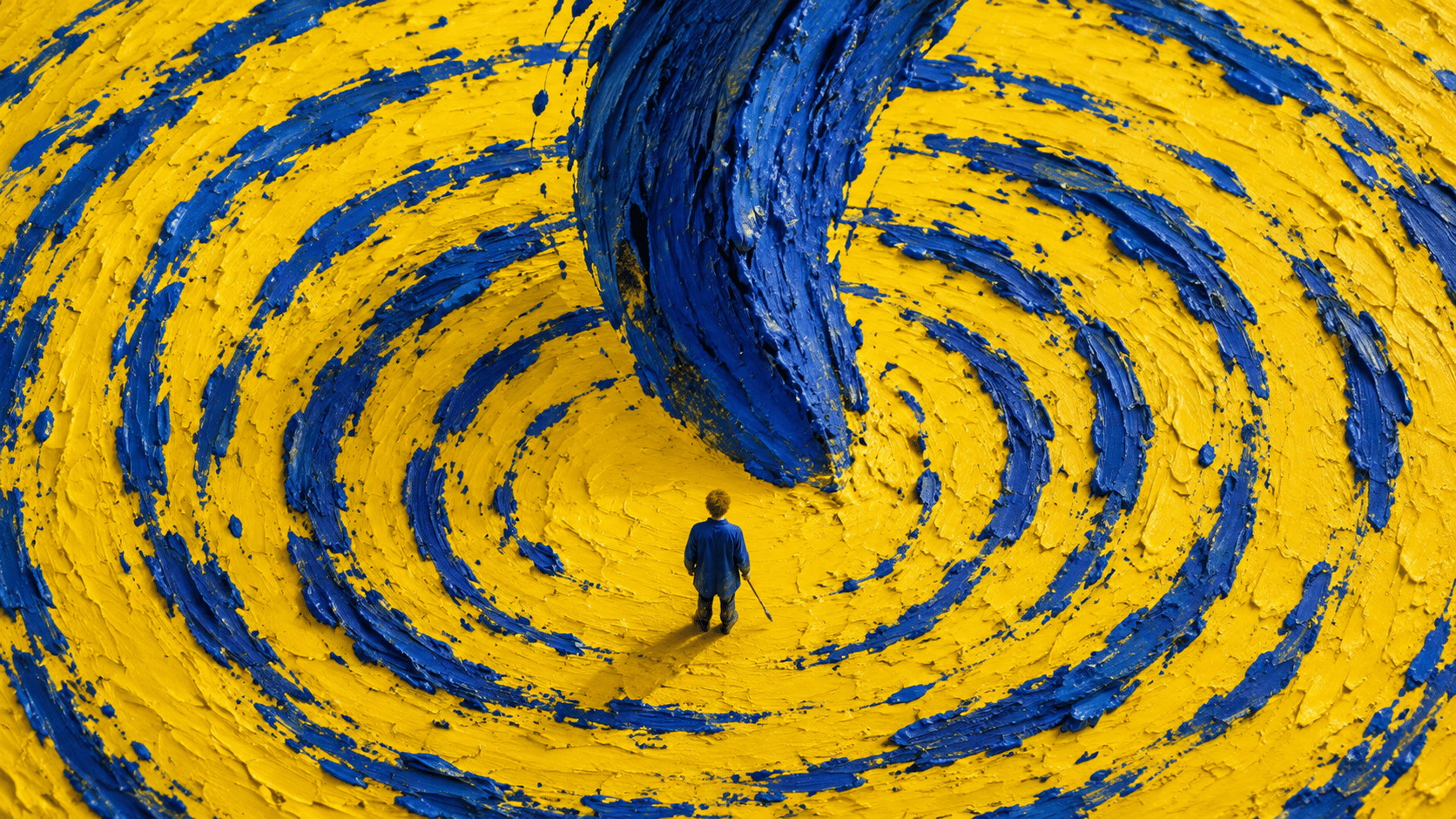
the canvas is closer to a boxing ring.
Every painting restarts the fight.
There is no final victory.
There is only the next round.
This is why one artwork is not enough.
Seeing only Sunflowers
is like walking into a stadium
with ten seconds left on the clock
and claiming you understand the entire match.
The greatness is in the duration of the struggle.
In repetition.
In obsession.
In quantity transformed into destiny.
Bad painting
Then comes the most offensive part
of Sgarbi’s argument.
In Van Gogh, he suggests,
the ugly begins to overpower the beautiful.
And this “bad painting”
opens one of the decisive paths
toward contemporary art.
Bad painting?
Exactly.
Bad according to the rules
of everything that came before.
Too much colour.
Too much matter.
Too much author.
Too little education.
The sky should not behave like that.
Olive trees should not twist like that.
A room should not lean like that.
A face should not reveal that much.
Van Gogh paints badly
in the same way a man breaks down a door badly.
Not elegantly.
But because he has to get through.
And through that broken door
a huge part of the twentieth century enters.
Expressionism.
The raw gesture.
The nervous line.
The artist’s body left inside the work.
The painting that no longer hides
what it cost to make.
Art before beauty
For centuries,
the painter had tried to master matter.
Van Gogh lets matter show the fight.
He does not hide the fatigue.
He does not erase the tracks.
He does not clean up
the scene of the crime.
The brushstroke remains there
as evidence of what happened
between a man and a canvas.
This is why his painting
does not only ask: Is it beautiful?
It asks: What did it cost the person who made it?
Not in money.
In presence.
In energy.
In life.
The artist in the swipe era
Today everything must work instantly.
An image must stop the thumb.
A title must capture attention.
An artist must become recognisable
before the audience gets bored.
Van Gogh is perfect for Instagram
and completely incompatible
with the logic of Instagram.
His images are immediately recognisable.
His work requires time.
The contemporary audience wants
the fetish painting.
The ready-made quote.
The detail for a tote bag.
The bedroom on a screen.
The sunflowers above the sofa.
Van Gogh asks for something much less comfortable.
Do not just look at the result.
Look at the insistence.
In the age of artificial intelligence,
making a beautiful image
becomes easier every day.
Building a coherent obsession
does not.
A machine can imitate a surface.
It is much harder
to construct necessity.
Van Gogh did not simply have a style.
He had something
that kept returning to find him.
The artwork is not the painting
With Maurizio Cattelan,
a banana can be eaten and replaced.
The material object
does not exhaust Comedian.
The concept is larger than the fruit.
With Van Gogh,
almost the opposite happens.
The individual canvas remains.
But it is not enough
to contain Vincent.
Cattelan makes the object replaceable
because the idea is larger than the banana.
Van Gogh makes the masterpiece insufficient
because the life is larger than the painting.
Two opposite operations.
The same crime.
Both artists move art away
from the safe place
where the public wants to keep it.
They move it into the invisible relationship
between idea, gesture and necessity.
Fifty paintings later
Look at one
and you will see sunflowers.
Look at fifty
and you will see a man
trying to remain standing.
Look at one
and you can decide
whether you like it.
Look at fifty
and the question starts
to feel irrelevant.
Maybe that is the point.
Important art is not always the art
that gives you the best answer.
Sometimes it is the art
that destroys the wrong question.
Van Gogh does not ask
to be found beautiful.
He asks to be followed.
Canvas after canvas.
Round after round.
Until yellow is no longer a colour.
But a fever.
Until the sky is no longer a landscape.
But a mind looking for a form.
Until the painter no longer seems
to be painting the world.
But holding it together
with both hands.
Long live Art Goes Banana.