and someone gave him change
chicago, 1984.
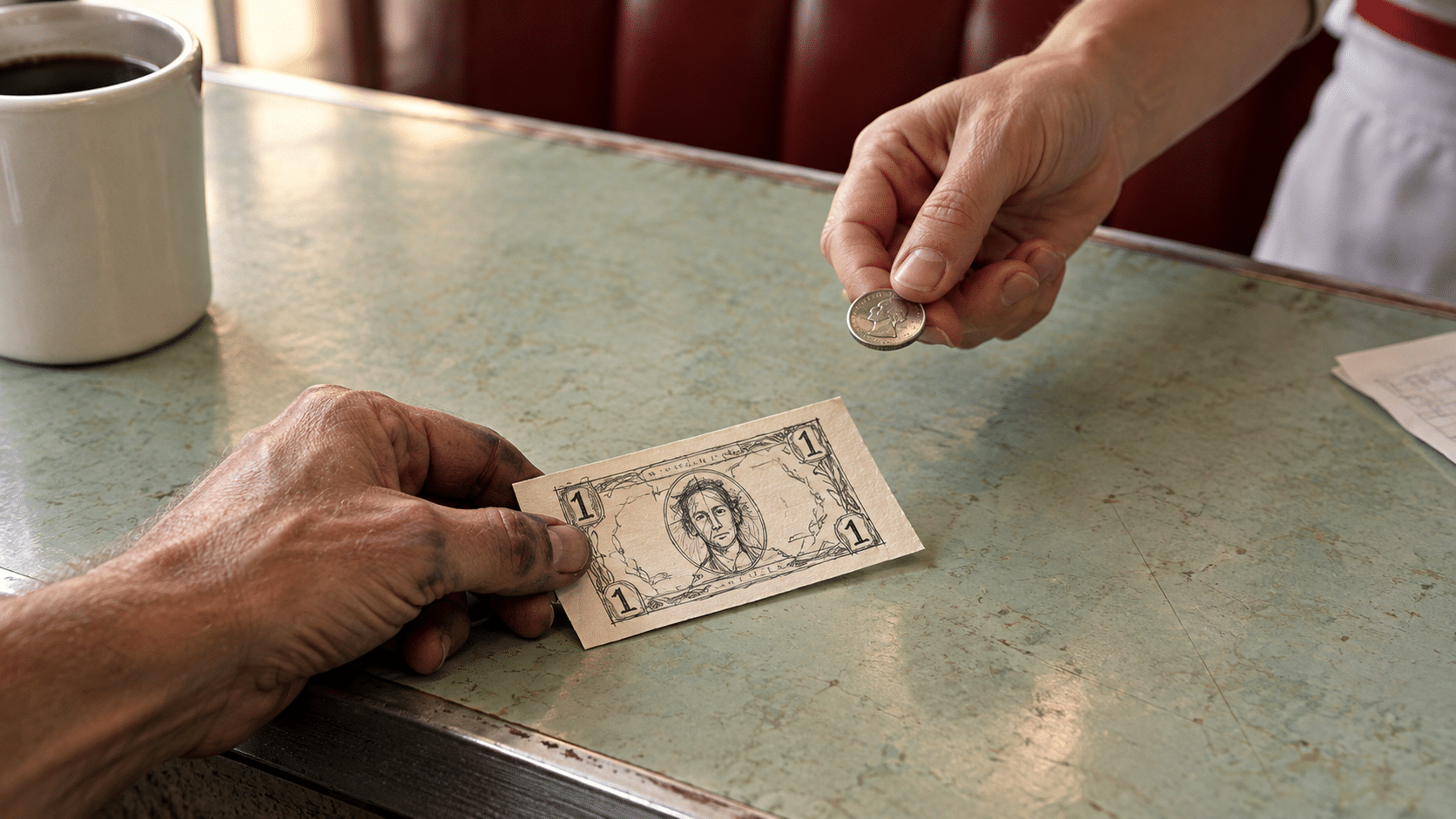
j.s.g. boggs is doodling a dollar bill in a diner.
his tab is ninety cents.
the waitress accepts the drawing
and gives him ten cents back.
that dime changes the story.
without it, the exchange could have looked like a gift, a curiosity, a favour.
with it, the arithmetic becomes explicit.
someone has treated a drawing as money.
boggs later called the feeling “electricity”.
for a moment, he might have felt like the mint of his own small state.
a state with two citizens and a diner for a treasury.
a mint made of conversations
from then on, boggs drew banknotes. typically on one side only, with deliberate differences: close enough to the real thing to provoke a question, different enough to invite a closer look.
then he tried to spend them. restaurants, shops, hotels.
he explained it was art, not official currency. he offered it at face value. the other person was free to say no.
many said yes.
the hand made the image.
the person across the counter decided what it could do.
the work continued beyond the artist.
someone else had to consider it, negotiate, participate.
their decision became part of the performance.
the paper keeps working
boggs generally avoided selling the notes directly to collectors.
he sold the receipt, the change, and information about where the drawing had been spent.
the collector had to track it down and negotiate a purchase from its new owner.
the price could now be far higher than face value.
the meal had been eaten. the merchant had been paid.
the paper was still working.
worth more, now, than the money it depicted.
a 1999 account reported one of his transactions selling for $420,000.
a long way from ninety cents and a dime.
even the receipt had acquired a second life.
proof of an ordinary purchase had become something worth purchasing.
what are you actually collecting?
a drawing fits in a frame.
the moment someone said yes doesn’t.
the collector could try to assemble that moment:
the drawing, the receipt, the change.
an artwork scattered across several hands.
the denomination. the goods. the labour. the scarcity. the story. the price the next person will pay.
none of them has to match the others.
scarcity alone explains nothing: a unique scrap of paper can still be worthless.
someone has to want it.
what exactly are we calling value?
what the paper says?
what it buys?
what someone offers for it next?
the number stayed on the paper.
the value happened between people.
the law had questions too
the law had questions too.
arrested in england in 1986, acquitted at the old bailey in 1987.
arrested in australia in 1989, acquitted again.
in the united states, the secret service seized his work without bringing counterfeiting charges.
but perhaps boggs was doing the pound a favour.
a ten-pound note from the bank of england was worth ten pounds.
his drawing of one could be worth thousands to a collector.
seen that way, he was not undermining the currency.
he was taking its design and making something people valued more than the money itself.
not a threat to the pound.
a rather expensive compliment.
at the old bailey, the jury reportedly took about ten minutes.
the waitress, the collector, the jury.
different encounters with his drawings.
different decisions about what they were.
the drawing kept producing decisions.
even the fake needed an original
then people started forging boggs.
fake versions of unofficial money.
buyers now had to check whether an unofficial banknote was a genuine boggs.
authenticity hadn’t disappeared.
it had just moved house.
nobody had to be fooled
we’ve written about how credibility gets staged: the lab coat, the letterhead, the box that sells out with nothing inside.
boggs made his proposal openly.
a drawing, a question, and someone free to answer.
and value appeared anyway.
like natura viva, the work only existed when someone took part.
both could see something to gain.
he received a meal or a room.
the other person received an original artwork, with the possibility of a further sale.
the agreement didn’t make his drawing legal tender.
it made a particular exchange possible.
a representation of money had produced consequences usually associated with money.
at what point does something become real enough to use?
the participant’s answer helped determine what the work could do.
a banknote carries a number.
boggs made people argue with it.
he drew a hundred.
they decided it was worth more.
even the money had been underpriced.
art had made paper worth more than the legal tender it represented.
nobody had to mistake the drawing for a real banknote.
a banknote is also paper.
it works because enough people, and a state behind them, keep agreeing to accept it.
boggs just made the agreement small enough to see.
the question was never what the paper says.
it’s who will give you change.
read also
how andy warhol made it ok to get rich from art