Eighty years after Buenos Aires, another collective picks up the paper
Buenos Aires, 1946.
A group of young artists, students at the Academia Altamira, gather around their teacher, Lucio Fontana.
Europe is in ruins. The atomic bomb is a year old.
Radio, cinema and aeroplanes have rewired how people see, hear and move.
Together they write a text and call it Manifiesto Blanco.
The White Manifesto.
Fontana inspired it but didn’t sign it. It belonged to a collective.
Italy, 2026.
Another collective, also allergic to the polite version of the art world, finds the text and reads it slowly.
The paper has aged. The ideas haven’t.
This is our reply.
Not a commentary and not a celebration.
A second manifesto, written over the first, the way you write in the margins of a book that changed your mind.
The manifesto was white. Now it’s about to go banana.
They asked science for help. Nobody answered.
The White Manifesto opens with a request that still sounds outrageous.
Art, it says, is a vital necessity of the species. So it asks the scientists of the world to direct part of their research towards a “luminous and malleable substance,” and towards instruments for sounds that do not yet exist, to make possible “the development of a four-dimensional art.”
Artists weren’t asking for funding, a residency or a seat at the table.
They were asking for matter, and for tools that didn’t exist.
They were commissioning the future.
Eighty years later, the request is still open.
Science has given us lasers, screens, synthesizers, holograms and machines that write.
Almost none of it was made for art.
Art borrowed it afterwards, the way it always does, picking up whatever the factory left behind.
We think the request deserves a second chance, and this time it needs a wider address.
In 1946 a clear line ran between the people who built tools and the people who used them.
In 2026 that line is dissolving.
A designer trains a model at the kitchen table. A writer builds software by describing it. A teenager runs experiments a laboratory couldn’t afford twenty years ago. With AI, everyone is potentially a scientist, and every scientist is potentially an artist.
The White Manifesto wrote to the men of science.
We’re writing to anyone curious enough to build something that doesn’t exist yet.
We’ll get to the letter. First, the reasons.
Ideas grow in the present
“Ideas are not rejected. They exist in germ within society; then thinkers and artists express them.”
This sentence breaks the myth of the genius.
There is no lightning from heaven.
New ideas are already here, half-formed, inside a society that changes faster than its vocabulary. The artist doesn’t make them from nothing. The artist notices them first and gives them a body.
We’d add one thing. In 2026 ideas don’t only grow in germ. They sit on the surface of everything, in plain sight, ignored because they arrive looking normal: a tool everyone uses without thinking, a habit that turned absurd without anyone saying so, a discomfort that still has no name.
Whoever names it first doesn’t own the idea.
They give it legs.
Every tool rewrites the person holding it
The Buenos Aires collective saw it clearly.
New physical forces and the mastery of matter and space impose conditions “that never existed in the entire course of history,” and with them a human being who “takes on a different psychological structure.”
Then comes the verdict:
“We live in the age of mechanics.
Painted cardboard and erected plaster no longer have any reason to exist.”
Replace “mechanics” with “artificial intelligence” and the sentence still holds.
That isn’t because they predicted AI.
They predicted the panic.
Every new tool gets called an insult to human intelligence.
The calculator was going to ruin arithmetic. Today nobody does long division at the checkout, and nobody misses it. Resistance to innovation is rarely about the tool itself.
It’s about competence suddenly looking temporary.
The useful question isn’t whether to be afraid.
It’s which of our skills truly belong to us, and which are just leftovers from an old tool. Fear clings to the leftovers. What makes us human usually survives the change, and often comes out stronger.
Not against painting.
A careless reading turns this text into a war on painting.
It isn’t one. The following year, in the First Spatialist Manifesto, Fontana and his co-signatories said so explicitly: nothing of the past will be destroyed, people will go on painting and sculpting, but those materials will be approached “with other hands and other eyes.”
The enemy is repetition. The 1946 text speaks of “oppressive repetitions,” and of arts stagnating in values foreign to their own civilization.
It’s still the enemy.
The world is full of artists perfecting the same aesthetics, a little more polished every year, with sharper resolution and better lighting, and the work is still dead.
You can perfect a dead language forever, and it stays dead.
Even revolutions get tired
The most underrated passage is a short history of modern art as a chain of escapes. Representation exhausted itself and was deformed, and deformation led to abstraction. Then the text turns: even abstraction “does not correspond to the needs of present-day man.”
Abstraction had been the radical answer, and they called it insufficient. Every avant-garde solves the problem of its own moment, then hardens into a style. The style becomes a comfort, and the comfort becomes a product.
Even the revolution needs revolutionising.
There’s also an aside on honesty. Futurism, they wrote, declared movement its only principle and its only aim. The Cubists denied their painting was dynamic, yet the essence of Cubism was nature seen in motion. One said what it was doing; the other did what it wouldn’t admit. We side with the first. A real break doesn’t hide.
Movement was not the cure
Then comes the passage that reads as if it were written this morning.
“The quiet life has disappeared. The notion of speed is constant in the life of man… Man grows increasingly insensitive to images nailed down without signs of vitality.”
In 1946 the diagnosis was stillness and the cure was movement: colour, sound, motion through space.
In 2026 everything moves. Images scroll, loop, autoplay and refresh, competing for half a second of a thumb. Pictures have never been less nailed down, and we are just as numb, maybe more: instant gratification, dopamine on tap, a thousand moving images a day and almost none of them alive.
So movement was never the cure.
Read the sentence again.
The word that matters is vitality.
An image can move all day and still be dead.
A single cut in a still canvas can be more alive than ten thousand clips. The problem was never stillness. It was emptiness, and speed has only made it easier to disguise.
That’s our “first amendment” to the White Manifesto.
Don’t ask whether a work moves, grabs attention or holds the feed for three seconds. Ask whether it leaves a sign of life in the person who meets it, one that wasn’t there before.
Matter is never finished
The text refuses to represent humans, animals or forms, which it calls passing manifestations of nature that change and disappear. It aims instead at matter itself and its evolution.
“Existence, nature and matter are a perfect unity. They develop in time and space. Change is the essential condition of existence.”
Matter exists in movement “and in no other way,” and its development is eternal.
An art built on that idea doesn’t end. It continues, following matter as matter changes, and quietly it changes the person watching. Nobody looks at evolving matter and stays the same.
A year later the idea found its finest form:
“Art is eternal, but it cannot be immortal.”
A gesture, once made, lives forever in the human spirit, while its material will die regardless. Artists, they wrote, had confused eternity with immortality: they chased durable materials and sacrificed the pure gesture to an impossible hope of lasting.
“It does not matter to us whether a gesture, once made, lives a moment or a millennium.”
Read that with anything you make in mind.
It will decay, be deleted or be forgotten, but the gesture, if it was true, stays done. That isn’t a loss. It’s the freedom to make things without begging the future to remember them.
The oldest sound
For a text so hungry for the future, it digs surprisingly deep. It starts in prehistory, with people hearing for the first time the sound of a blow on a hollow body and being “subjugated by its rhythmic combinations.”
The most radical future begins with the oldest experience. That’s not nostalgia but excavation. Innovators who last don’t simply reject the past. They dig beneath it, back to the moment before habits formed, when an experience was still raw, and they build forward from there.
Reason [alone] does not create.
“Reason does not create.”
It sounds anti-intellectual, but it’s probably the opposite. Rationalist artists who deny the subconscious, the text argues, don’t remove it; they only make it less visible, and it works in every one of their works anyway. Then the real point: humans function with the totality of their faculties. Analysis and synthesis, meditation and spontaneity, construction and sensation join in one working unity, developed through experience, “the only path that leads to a complete manifestation of being.”
That isn’t a choice between head and gut.
It’s a refusal to choose. It’s a winning, and balanced, combo.
This matters more now than it did in 1946. Machines are getting very good at the rational part: assembling, optimising, completing.
Fine. That was never the whole of creation.
What machines lack is the part the text puts first, the dark and unruly drive that wants something before it knows what.
A prompt doesn’t create either.
Something still has to be wanted.
After the separation, the synthesis
The boldest claim comes near the end. For millennia art developed analytically, with painting in one place, music in another, poetry and architecture somewhere else. That separation was once necessary. “Today it constitutes a disintegration of the conceived unity.” The moment of synthesis has come: colour as the element of space, sound as the element of time, and movement unfolding through both.
Colour. Sound. Movement.
That’s what their “fourth dimension” means.
It isn’t a science-fiction gadget but an art that stops respecting the borders between disciplines, because reality never respected them.
We’d push it further.
In 2026 the borders dissolving aren’t only between painting and music.
They run between art and science, art and code, art and fashion, art and what we throw away, art and the way we live.
Synthesis is no longer a genre.
It’s the condition.
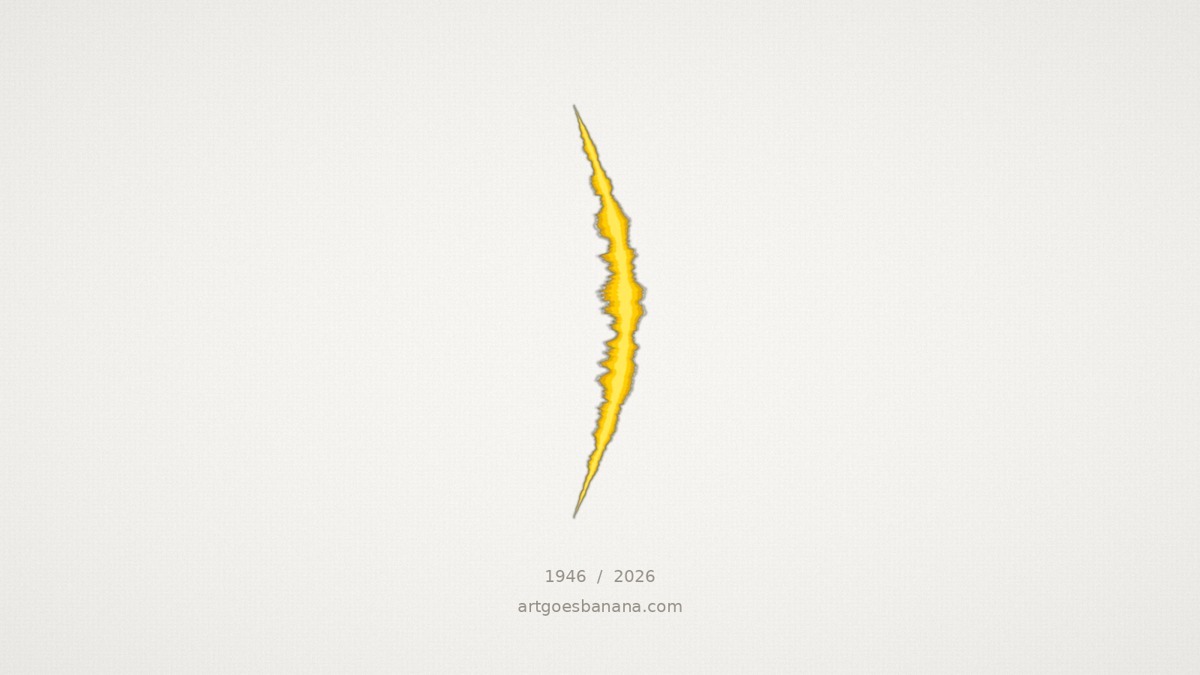
The cut ends the canvas’s monopoly on space
Then Fontana did what the words demanded: first holes, then cuts.
The usual story says the cut lets light into the darkness behind the canvas.
That’s true, but it isn’t enough.
The cut ends the canvas’s monopoly on space.
For five centuries a painting was a window, a flat surface pretending to contain the world. All the space that mattered was painted inside it, and the gaze stopped there. The White Manifesto traces this history: space represented ever more broadly over the centuries, the Baroque adding time, figures that seem to leave the plane. It was always represented, and always inside the frame.
Fontana stopped representing space and let real space in. After the cut, the canvas is no longer a world. It’s an object in the world, with a front, a back, a shadow and a wound. The darkness behind it isn’t emptiness. It’s the wall, the room, the real air the painting had hidden for five hundred years.
That’s why the cut isn’t violence. It’s honesty: the canvas finally admits it was never all of space, only one surface within it.
The gesture reaches beyond art.
Every field has its own canvas, a closed system that has quietly claimed a monopoly on what counts as real: the proper format, the accepted method, the only serious way to do things.
The pioneer doesn’t paint a better picture on that surface.
They find the exact point where the surface pretends to be the world, and they open it.
The letter
So here it is: the request of 1946, sent again to a wider address.
To the scientists, engineers and researchers of 2026.
And to everyone who now holds tools that once belonged only to laboratories: designers, coders, writers, makers, the curious, the restless.Eighty years ago a collective in Buenos Aires asked your predecessors for a luminous, malleable substance and for instruments that would make a new art possible. The request was never really answered.
We are asking again.
What is the luminous, malleable substance of our time?
What material, tool or system exists today, or could exist tomorrow, that would let art do something it has never done?
Which surface in your field is pretending to be the whole of space?We don’t want a product. We want new opportunities.
Write to us. Every answer will be read and kept.
When an answer deserves it, we’ll publish it: here, on a new page, or only for the people on our list.
Art Goes Banana, an Italian art collective
404@artgoesbanana.com
This article is not finished
We’re declaring it now, so nobody can say we didn’t: this text is a work in progress, deliberately and permanently.
The White Manifesto said that art is eternal but not immortal, and that the gesture matters more than the matter holding it.
We’re taking that literally. This page will change. Replies to the letter will be added to it. Some will reach only the people on our waitlist and then vanish. Others may grow into new texts, new objects and new manifestos.
One collective wrote in 1946. Another answers in 2026.
Someone else will answer us, in a lab, at a kitchen table, or eighty years from now.
That isn’t a series of articles. It’s one long gesture, passed from hand to hand.
The White Manifesto went banana. Keep it going.
Translations from the Italian by Art Goes Banana.
Some replies to the letter will only ever be read by people on this list. → Get on the List: Not a Newsletter