The People Who Launch Possibilities
Most artists are told to find a style.
A palette.
A recognisable gesture.
A medium they can repeat until repetition becomes a career.
Then there are the others.
They do not simply make better-looking versions of familiar things. They introduce a possibility that was not available before.
A contract becomes an artwork.
A receipt becomes a ritual.
A social-media feed becomes a stage.
A book becomes an exhibition.
A canvas becomes a threshold rather than a surface.
These are startup artists.
Not artists with pitch decks. Not founders in studio clothes. Not people who discovered “disruption” and immediately ordered a neon sign.
An artist startupper is a pioneer: someone who changes the conditions under which art can exist, circulate, be owned, be experienced or be discussed.
Money may follow. Attention may follow. A market may appear later.
But none of that is the engine.
The engine is the new possibility.
Guerrilla Is a Tactic
Sometimes startup artists use guerrilla tactics: uninvited interventions, unexpected appearances, public interruptions, hijacked commercial or institutional spaces.
Guerrilla art is generally associated with work that appears outside authorised art spaces: in streets, billboards, media channels and places where art was not expected.
But surprise is not enough.
A work can be illegal and still be predictable. It can occupy public space and say nothing new.
Startup art goes further:
Guerrilla art enters a space without permission.
Startup art changes the rules of the space.
The first is an intervention.
The second leaves behind a new way of thinking.
The Outsider Advantage
The artist startupper looks at systems that most people accept as natural: galleries, auctions, contracts, advertising, museums, social media, property, celebrity, news, data and money.
Then they pull those systems apart.
They exaggerate their logic. They mock their rituals. They expose their hidden rules. Sometimes they make them work better. Sometimes they make their absurdity impossible to ignore.
This is why outsider artists matter, not because they are innocent, but because they are less likely to mistake tradition for necessity.
The gallery may be a distribution system.
A contract may be a performance.
A receipt may be a faith document.
A social feed may be a theatre of belief.
A painting may be a physical limit waiting to be broken.
The outsider sees that the system is made of choices.
The pioneer proves those choices can be changed.
Lucio Fontana: A Canvas Is Not Flat
Lucio Fontana did not cut a canvas because he had run out of things to paint.
He cut it because he refused the idea that painting had to end at the surface.
The slash created depth, darkness, space and a relationship with light. It made the canvas feel less like an image and more like a body with a front, a back and a wound.
Fontana’s Spatial Concepts used cuts and holes to challenge painting’s limits and engage space, depth and light. They emerged from his wider attempt to find an artistic language for a technological, postwar world.
He did not improve the canvas.
He changed what a canvas was allowed to be.
Seth Siegelaub: The Exhibition Was a Book
Seth Siegelaub is one of the essential figures for anyone interested in art that refuses its assigned container.
In 1968, he organised The Xerox Book, a project in which artists were given pages rather than gallery rooms. The catalogue was not a record of the exhibition.
It was the exhibition.
No walls.
No art handlers.
No opening-night performance of pretending to understand everything.
No obligation to visit a particular place at a particular time.
The work travelled through paper. It could be mailed, archived, borrowed, lost, rediscovered and still operate as an exhibition.
Siegelaub also helped develop the Artist’s Reserved Rights Transfer and Sale Agreement in 1971, using legal language to protect artists’ continuing interests as their work moved through the market.
That was not administration around art.
It was a challenge to the art system itself.
Distribution is not what happens after art is made.
Distribution can be the medium.
Tino Sehgal: Art Without a Thing
Tino Sehgal creates constructed situations: live works made of movement, song, conversation, choreography and encounter.
There is no conventional object to transport, insure, store or photograph. The work lives through performers and audiences.
When museums acquire his works, the transaction can happen orally, in front of witnesses, without the usual written contract, physical object or certificate.
Sehgal turns the art market’s usual certainties upside down.
The buyer acquires responsibility rather than a thing.
The museum preserves a living situation rather than material.
The viewer does not merely observe the work.
The viewer helps activate it.
His art is not anti-market.
It is a precise intervention into the rules that normally define ownership, documentation and permanence.
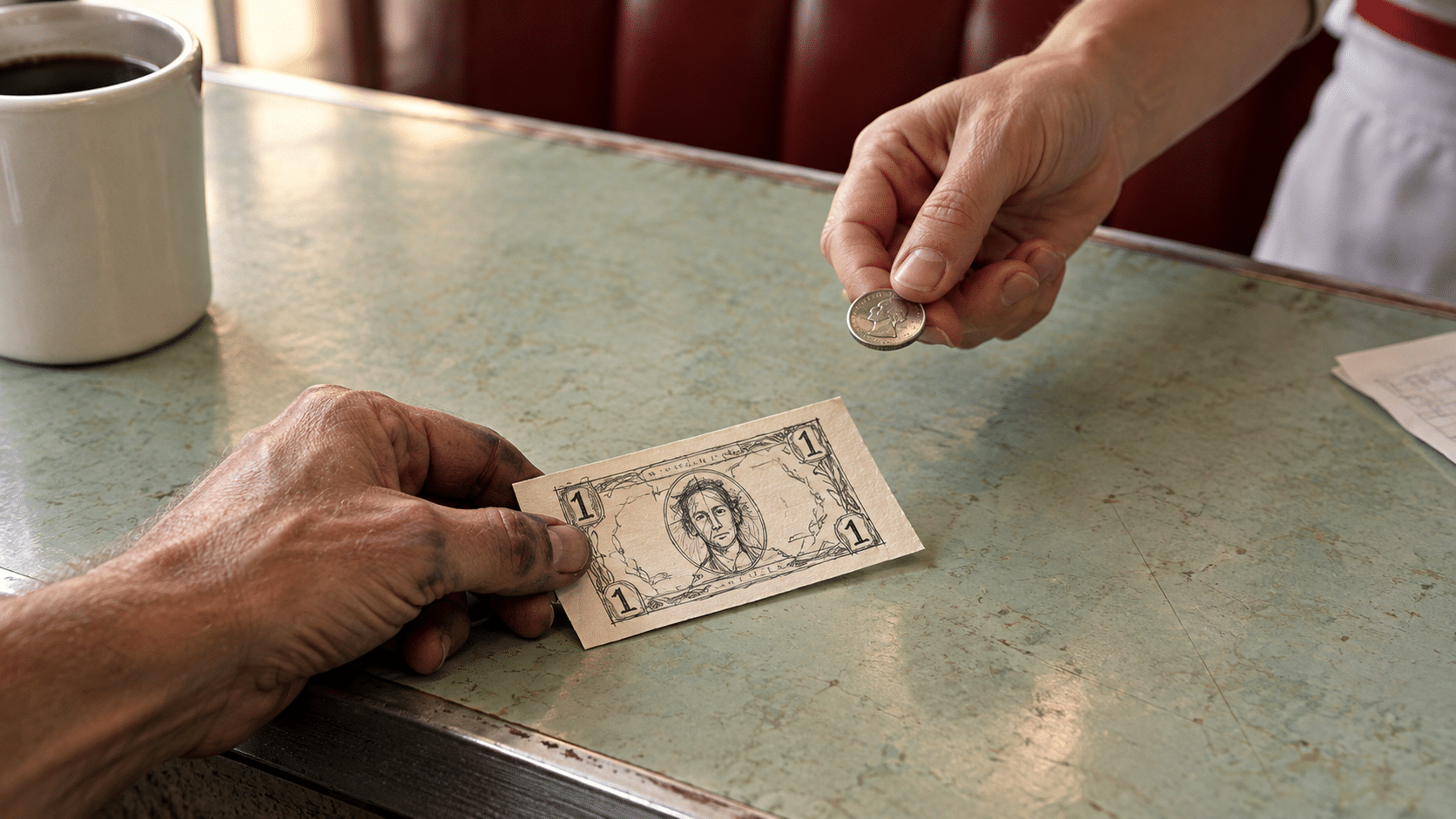
Yves Klein: The Receipt for Empty Space
Yves Klein sold invisible zones of artistic sensibility in exchange for gold.
The collector received a receipt. But to complete the ritual, the buyer could burn the receipt before witnesses, while Klein threw half of the gold into the Seine.
The work included the empty space, the gold, the sale, the receipt, the destruction of the receipt and the collective act of watching.
Klein made value visible by making it absurd.
He showed that ownership depends on belief, ritual and proof, and that proof can be destroyed without making the work disappear.
The receipt was not an accessory.
It was part of the artwork’s nervous system.
Amalia Ulman: The Feed Was the Work
In Excellences & Perfections, Amalia Ulman constructed a long performance through Instagram posts, captions, images and transformations.
For months, her account appeared to document a real life unfolding through familiar online archetypes: self-improvement, beauty, aspiration, vulnerability, reinvention and the demand to become an image worth following.
The point was not to use Instagram as a gallery.
The point was to reveal that Instagram was already a stage, a marketplace of identities and a machine for producing belief.
Ulman did not stand outside the system and criticize it.
She entered it, performed its logic perfectly, and let the audience reveal the system to itself.
How to Spot One
A startup artist rarely announces themselves as one. Look instead at what breaks around the work: a legal category that didn’t exist before, a museum department unsure who should catalogue it, a market unsure how to price something with no object attached, an audience arguing about what they even witnessed. The confusion is not a side effect. It is the readout instrument. If nobody is confused, the possibility probably already existed.
What Art Goes Banana Does
Art Goes Banana is interested in artists who do not accept the default settings.
The ones who see that a museum can become a conversation, a contract can become an object, a catalogue can become an exhibition and a screen can become a public theatre.
We do not want to make strange art safe by explaining it politely.
We want to follow the point where art becomes unstable, where it leaks into law, commerce, technology, media, public space and ordinary behaviour.
And sometimes we want the writing to do the same.
Startup art is not art that looks like the future.
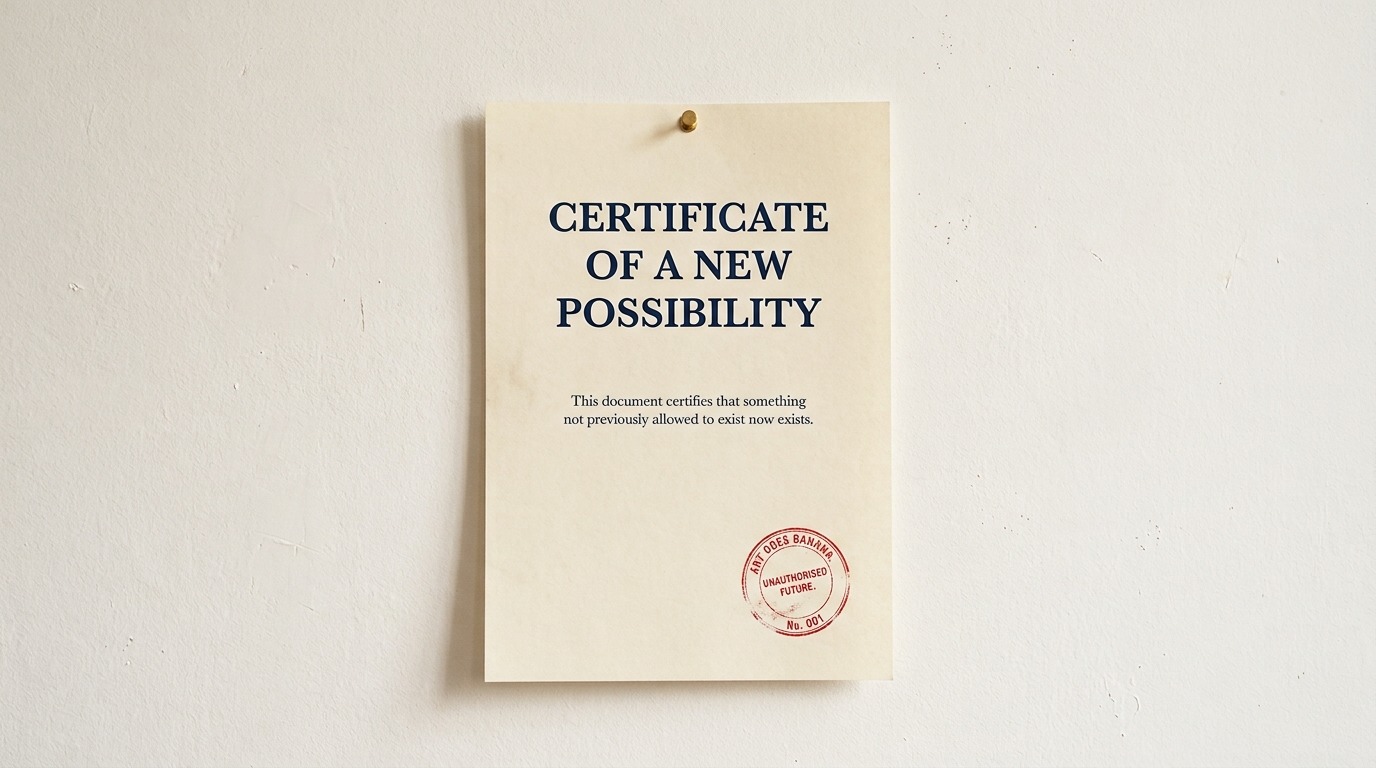
It is art that forges the future and makes it less predictable.